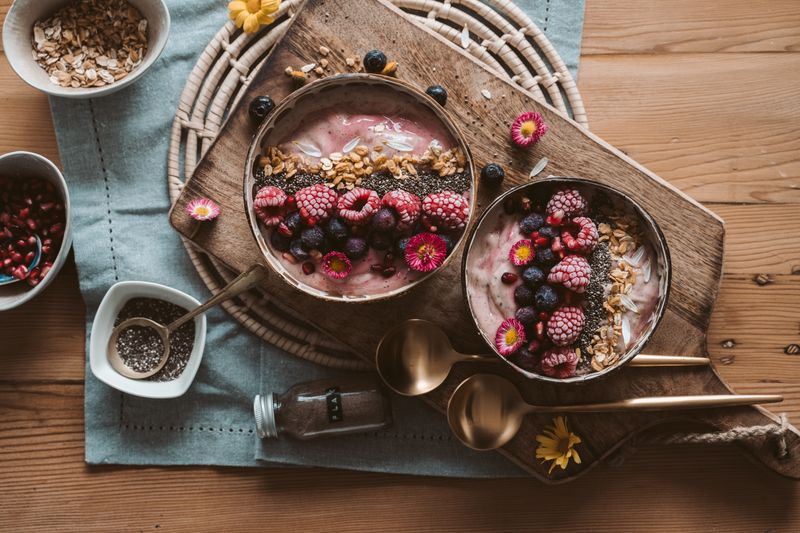
5 fruits and vegetables a day: why that number, and how to get there
Where the famous “5 a day” rule comes from, what the science really says — and above all, concrete ways to get there even on packed days.
Where does the “5 a day” rule come from?
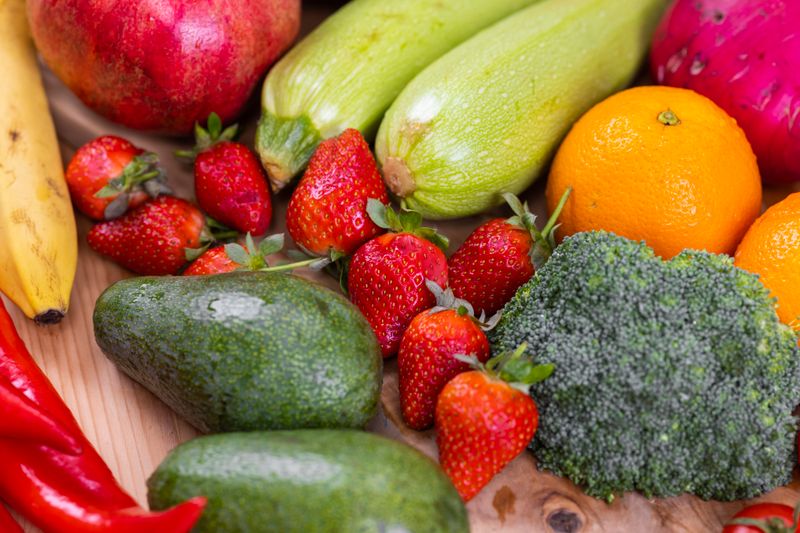
The World Health Organization recommends at least 400 g of fruits and vegetables per day, not counting potatoes and other starches. Split into portions of roughly 80 g, that makes 5 portions — hence the “5 a day” repeated by public-health campaigns since the 2000s. It isn’t a magic number: it’s a minimum threshold, chosen because it is both effective for health and, in theory, achievable in daily life.
What the science really says
The largest synthesis on the topic (Imperial College London, 2017) reviewed 95 studies covering about 2 million people. The result: compared with a diet containing very little, 5 portions a day are associated with a clearly lower risk of cardiovascular disease and premature death. And the benefits keep growing up to about 800 g a day — in other words, every extra portion counts.
Why such an effect? Because fruits and vegetables bring together fibre, potassium, vitamins C and B9, and thousands of plant compounds such as polyphenols. No single supplement reproduces that combination: it’s the whole package that works.
What counts as an 80 g portion?
- 1 medium apple, banana or orange
- 1 handful of berries or grapes
- ½ plate of raw vegetables or salad
- 3 tablespoons of cooked vegetables
- 1 smoothie made from real whole fruit, fibre included
Why almost nobody gets there
In Belgium, the national health survey (Sciensano) shows that barely 1 adult in 10 reaches 5 daily portions. The number-one reason isn’t lack of will: it’s time. Buying fresh fruit, washing, peeling, cutting — then throwing away what you didn’t have time to eat. Monday’s good intention often fades by Thursday.
Whole fruit, juice or smoothie: is it the same?
No. Filtered juice loses most of the fibre, and the fruit’s sugar then hits the bloodstream much faster. Whole fruit — or fruit blended whole, fibre included — remains the gold standard. That’s why the recommendation says “fruits and vegetables”, not “glasses of juice”.
How to get there without changing your whole day
- Attach each portion to a moment that already exists: breakfast, the 10 am break, snack time, after sport
- Always keep a ready option at the office or in your bag
- Add berries to a yoghurt instead of a biscuit
- Favour formats that need no cutting, no blender, no washing-up
- Aim for consistency, not perfection: 5 days out of 7 already makes a real difference
The trap to avoid
Waiting until you have time to cook. In real life, days overflow — and an unsustainable resolution does less good than a small habit you actually keep every day.